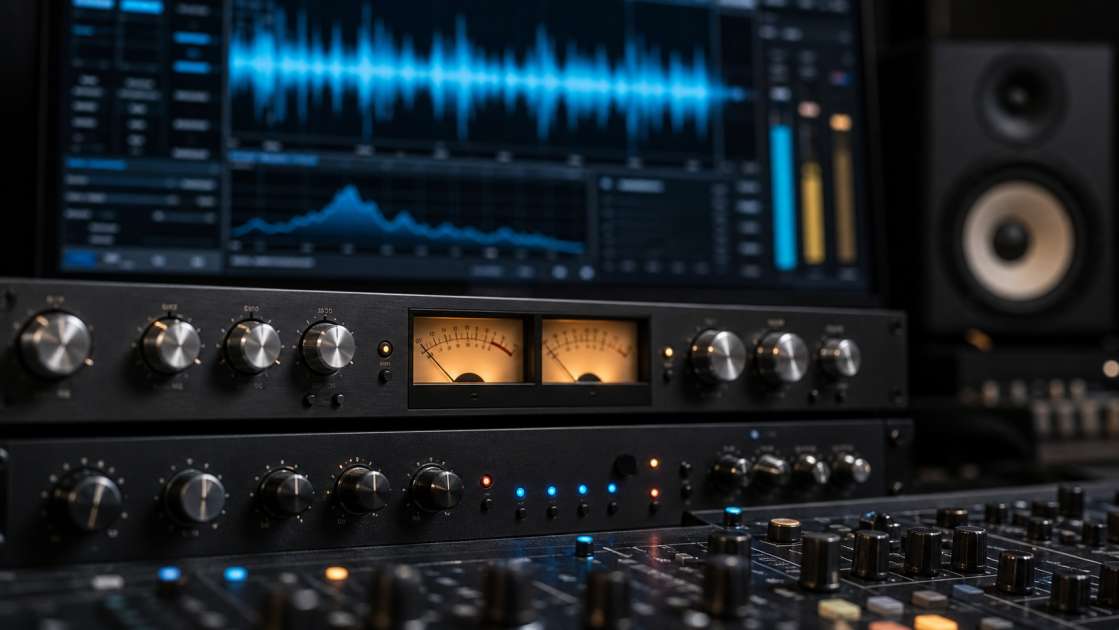
When you generate a track with Suno, the output often sounds decent at first listen, but A-B it against a professional release and the differences become obvious. The low end might feel muddy, the vocals sit oddly in the mix, or the overall loudness falls short of what streaming platforms expect. This is where a suno mastering tool becomes necessary. Mastering is not about fixing a broken mix, but it can address tonal imbalance, control peaks, add perceived loudness, and make your AI-generated track hold up better in playlists.
Quick answer: a suno mastering tool applies EQ correction, multiband compression, saturation, stereo width adjustment, and limiting to bring your Suno track closer to commercial loudness standards without sacrificing dynamic range. Most effective mastering for Suno tracks involves exporting the highest quality audio file available, applying corrective EQ to remove harshness or boxiness, controlling peaks with transparent compression, then using a limiter to reach approximately -14 LUFS integrated loudness for streaming. Free options exist, but results depend heavily on the condition of the source material.
Why Suno Tracks Need Mastering at All
Suno generates complete stereo mixes, which means you do not have access to individual instrument stems by default. The AI makes mixing decisions during generation, and those decisions are not always optimal. Common issues include uneven frequency distribution, excessive sibilance in vocals, narrow stereo image, or peaks that prevent the track from achieving competitive loudness. The mastering stage is your chance to correct these problems within the limits of a fixed stereo file.
Another reason mastering matters is loudness normalization on streaming platforms. Spotify, Apple Music, and YouTube all target around -14 LUFS integrated loudness. If your Suno track measures -18 or -20 LUFS, it will sound quieter than the songs before and after it in a playlist. A suno mastering tool brings your track up to that target without introducing distortion or pumping artifacts.
Mastering also addresses tonal balance. Suno sometimes produces mixes with too much energy around 2 to 4 kHz, which makes vocals sound harsh or metallic. Other times the low end is either too thin or too boomy. A parametric EQ in the mastering chain can smooth these imbalances and make the track feel more cohesive across consumer playback systems like earbuds, laptop speakers, and car stereos.
Exporting the Best Source File for Mastering
Before you apply any suno mastering free plugin or paid tool, make sure you have the highest quality file Suno provides. Download the track in the best available format. If Suno offers a lossless or high-bitrate option, use that. Avoid re-encoding MP3 files multiple times, because each lossy compression pass degrades the audio further and introduces artifacts that no mastering process can remove.
If you used Suno's stem separation feature to export individual instrument and vocal stems, consider doing a quick stem cleanup pass before mastering. This means using a spectral editor to remove metallic artifacts from the vocal stem, applying a de-esser to control sibilance, and using surgical EQ cuts to remove resonances or hiss. Then bounce the corrected stems back to a stereo mix and master that new mixdown. This extra step takes time but yields better results than mastering a flawed stereo file directly.
When exporting your corrected mix for mastering, use WAV or FLAC at the same sample rate and bit depth Suno provided. Do not apply normalization or any loudness maximizer at this stage. Leave headroom of at least -3 dB on the master fader so the mastering limiter has room to work without clipping.
EQ Adjustments in the Mastering Chain
The first processor in most mastering chains is an equalizer. For mastering suno tracks, I typically start with a high-pass filter around 30 Hz to remove subsonic rumble that wastes headroom and adds no musical value. Then I listen for problem areas. If the vocals sound harsh or the snare cuts too aggressively, I look for peaks between 2.5 and 5 kHz and apply narrow cuts of 2 to 4 dB.
Boxiness or nasal tone often lives around 400 to 800 Hz. A broad cut of 1 to 2 dB in this range can open up the mix and reduce muddiness. If the low end feels too boomy, a gentle cut around 120 to 200 Hz can tighten the bass and kick drum. These EQ moves are subtle because you are working on a finished stereo mix. Aggressive cuts can create phase issues or make the mix sound thin.
Sometimes Suno tracks lack air or sparkle in the high frequencies. A gentle shelf boost above 8 kHz, around 1 to 2 dB, can add perceived clarity without emphasizing sibilance. Be careful with this move if the vocal already has harsh s sounds. In that case, use a de-esser before the high shelf so you add air without exaggerating problems.
Compression and Multiband Dynamics
Mastering compression is different from mix-bus compression. The goal is not to glue elements together but to control the dynamic range gently so the limiter does not have to work as hard. I use a slow attack, medium release, and a ratio between 1.5:1 and 3:1. Aim for 1 to 2 dB of gain reduction on the loudest peaks. This modest compression helps the track feel more consistent without squashing transients or making the mix sound flat.
Multiband compression can be useful for mastering suno tracks that have uneven frequency balance. For example, if the vocals are too dynamic in the midrange but the bass is already controlled, you can apply compression only to the 500 Hz to 3 kHz band. This selective approach avoids overprocessing the entire mix. Be conservative with multiband tools because they can introduce phase shifts and smear transients if pushed too hard.
Some engineers prefer using a mastering-grade saturator instead of heavy compression. Saturation adds harmonics that make the track feel louder and warmer without reducing dynamic range as much as compression. Tape or tube emulation plugins work well for this purpose. Keep the saturation subtle, just enough to add body and perceived loudness, not so much that you hear obvious distortion.
Stereo Width and Imaging
Suno mixes sometimes have a narrow stereo image, which makes the track feel small or mono-like. A stereo widener can help, but use it carefully. Excessive widening causes phase issues that make the mix sound weak on mono playback systems like phone speakers or certain Bluetooth devices. I usually apply subtle widening only above 200 Hz, leaving the low end centered to maintain punch and avoid phase cancellation.
Another approach is mid-side EQ, where you process the mid and side channels separately. Boosting the side channel in the high frequencies can create a sense of width and air. Cutting the side channel in the low frequencies ensures the bass stays focused in the center. This technique is more transparent than a stereo widener plugin but requires a plugin that supports mid-side processing.
Always check your master in mono before finalizing. If important elements disappear or the mix sounds thin when summed to mono, reduce the stereo widening or adjust the mid-side balance. Many streaming services and broadcast systems still use mono or pseudo-mono playback at times, so mono compatibility is not optional.
Limiting and Loudness Targets
The final stage in any suno mastering tool chain is the limiter. The limiter's job is to catch peaks and allow you to increase the overall level without clipping. Modern true-peak limiters prevent inter-sample peaks that can cause distortion during lossy encoding. Set the ceiling to -1 dBTP to leave a small safety margin.
For streaming platforms, target around -14 LUFS integrated loudness. You can measure this with a loudness meter plugin that displays LUFS values. Push the input gain on your limiter until the loudness meter reads close to -14 LUFS. Some genres sound better slightly quieter at -15 or -16 LUFS to preserve dynamics. Other genres like EDM or pop often sit closer to -13 or -12 LUFS, but be aware that louder is not always better. Excessive limiting creates a flat, fatiguing sound.
If you notice pumping or distortion when the limiter engages, reduce the input gain or adjust the release time. A faster release can sound more transparent but may introduce distortion on bass-heavy material. A slower release is smoother but can cause pumping on tracks with fast transients. Listen carefully and find the setting that works for your specific track.
Free Versus Paid Mastering Tools for Suno
Many suno mastering free options exist, including open-source plugins and online mastering services that offer basic processing at no cost. Free limiters like LoudMax or the limiter included in Audacity can bring your track up to streaming loudness. Free EQ plugins like TDR Nova provide surgical control over problem frequencies. These tools are capable, but they require you to know what adjustments to make. Automated free mastering services apply presets that may or may not suit your track.
Paid mastering plugins and services offer more sophisticated algorithms, better metering, and often more transparent processing. Plugins like Ozone or FabFilter Pro-L2 include intelligent features like dynamic EQ, spectral shaping, and advanced limiting modes. Paid online mastering services employ engineers or AI trained on larger reference libraries, which can produce more polished results. The trade-off is cost and sometimes a longer turnaround time.
For hobbyists mastering one or two Suno tracks, free tools are usually sufficient if you invest time learning how to use them. For producers mastering multiple tracks or aiming for commercial release quality, paid tools save time and often deliver better results. There is no universal right answer, just different priorities around budget and desired outcome.
Testing and Reference Listening
Mastering is not a set-and-forget process. After applying your suno mastering tool chain, export the mastered file and listen on multiple playback systems. Check the track on studio monitors, consumer earbuds, laptop speakers, and in a car if possible. Problem frequencies or excessive compression that sound acceptable on one system often become obvious on another.
Use reference tracks from commercial releases in the same genre. Load a reference track into your DAW alongside your mastered Suno track and match the levels using a loudness meter. Compare the tonal balance, stereo width, and overall impact. If your track sounds darker, brighter, narrower, or less punchy than the reference, adjust your mastering chain accordingly. This comparison is more useful than trying to guess what sounds good in isolation.
Take breaks during mastering. Ear fatigue is real, and after an hour of listening to the same track your judgment becomes unreliable. Come back the next day with fresh ears and you will hear issues you missed before. Mastering is a detail-oriented process that benefits from patience and multiple listening passes.
When Mastering Cannot Fix the Problem
Mastering has limits. If the Suno generation produced a vocal with extreme metallic artifacts, clipping distortion, or a badly unbalanced mix, no mastering tool will make it sound professional. In those cases, the better path is to regenerate the track with adjusted prompts, use stem separation to isolate and repair problem elements, or accept the flaws and move on. Mastering works best on source material that is already close to acceptable.
Sometimes the issue is not technical but creative. A Suno track might be technically clean but lack emotional impact or interesting arrangement. Mastering cannot add musicality or fix boring composition. If the track does not connect with listeners, consider whether the problem is really in the mastering stage or earlier in the generation and mixing process.
For serious projects, consider hiring a mastering engineer. A skilled human can make judgment calls that automated tools and presets cannot. Engineers listen for context, genre conventions, and artistic intent. They adjust processing based on what the song needs, not just what a preset suggests. This personalized approach costs more but produces results that stand up to commercial standards.